 Odos
Odos Router enabled multi-token swaps before shutdown
Odos was a decentralized exchange aggregator that combined smart order routing with multi-token swaps in a single transaction. It supported exchanging one token for another, consolidating several inputs, and dividing outputs among different tokens. Its router controlled authorized token transfers and enforced specified minimum outputs, while the routing engine selected exchange paths. The operating company set July 30, 2026, as the permanent shutdown date for its services, following a read-only app phase starting July 27. Those dates ended the hosted trading service, while assets remained onchain and the ODOS token had a separate status. The documented swap design also covered approvals, referral fees, compact calldata, liquidity zaps, and optional output hooks.
updated
The routing engine, executor, and router had separate jobs
The routing engine searched possible token-swap combinations across liquidity sources, while an executor carried out the contract interactions encoded in a selected path. Router V3 wrapped that execution with token-transfer and output rules. The integrated trading sources supplied liquidity; the router handled authorized token transfers and output accounting.
The app presented token selection and output-allocation controls. A public API offered integrations access to single and multi-token swapping and token prices. Pricing data described a value; it did not establish a completed exchange.
An approved Router V3 swap moved through settlement
For the documented single-input ERC-20 path, a direct router allowance authorized spending before the swap call could transfer the chosen input. Approval alone moved no tokens. The exchange then followed the contract's execution and settlement rules.
| Swap stage | Token authority and settlement rule |
|---|---|
| Router approval before execution | The wallet held the tokens; its ERC-20 allowance authorized the router to spend. |
| Specified input transfer | The router moved the specified input amount to the configured input receiver. |
| Specification checks and path execution | The router validated output specifications; the executor performed the encoded exchange path. |
| Fee and surplus accounting | The router measured the output increase and applied configured fee and surplus rules. |
| Minimum-output enforcement | An amount below the specified output minimum reverted the swap. |
| Recipient settlement | The router paid the configured recipient; a zero recipient field selected the caller. |
This path applied the output minimum after fee and surplus accounting. Permit2 supplied an alternative authorization mechanism, and optional hooks extended the swap with a later contract call.
Single and multi-token swaps served different exchange tasks
Router V3 provided a dedicated one-to-one swap path alongside multi-token paths that combined inputs or distributed outputs within one atomic transaction. The dedicated single path was designed for slightly better gas efficiency. Atomic execution meant the included exchanges succeeded together or reverted together.
Combining several inputs
Many-to-one swaps consolidated selected input tokens into one output asset. Many-to-many swaps retained several outputs as well. These modes supported wallet consolidation and rebalancing without requiring a separate swap for every input token. A multi-token exchange on a supported network did not itself establish a transfer to another blockchain.
Allocating several outputs
One-to-many swaps distributed one selected input among different output tokens. The app's allocation controls let users set percentages for that distribution. Quoted output quantities and minimum amounts governed settlement, so an allocation preference and a minimum receipt expressed different requirements. Router V3's multi-token implementation checked each specified output against its own minimum amount.
What changed when the app became read-only?
July 27, 2026, marked the app's read-only phase, stopping trading while preserving access to balances and transaction history until the July 30 shutdown. New account registrations, wallet creation, and new limit orders had already stopped on July 23. Existing users had a remaining trading window before read-only mode began. The permanent closure applied to company-operated services, including the app and API, with no further development, support, or maintenance from the team.
Wallets created through social or email login had a specific wind-down instruction: transfer assets to another wallet or export the private key before July 30. The announcement also said wallet access and instructions would remain available after shutdown. Assets held in an external self-custody wallet remained onchain under the wallet owner's control. The aggregator's closure did not convert those holdings into company-held exchange deposits. The service deadline has passed.
Custom tokens depended on liquidity and network support
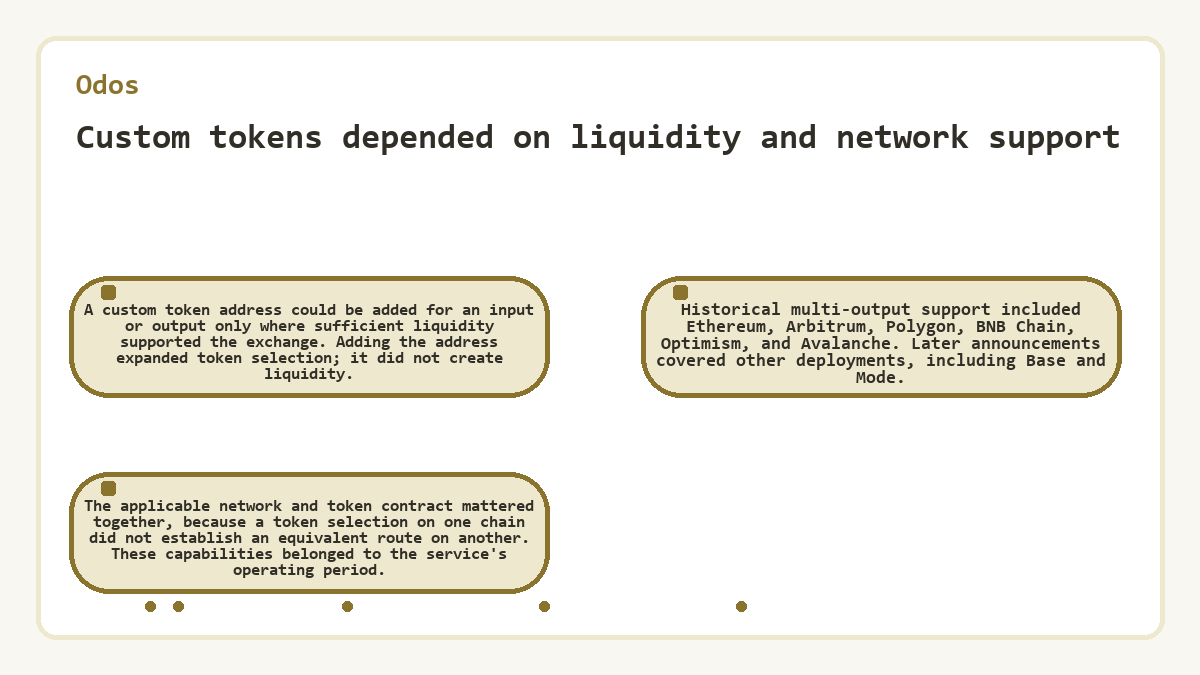
A custom token address could be added for an input or output only where sufficient liquidity supported the exchange. Adding the address expanded token selection; it did not create liquidity. Historical multi-output support included Ethereum, Arbitrum, Polygon, BNB Chain, Optimism, and Avalanche. Later announcements covered other deployments, including Base and Mode. The applicable network and token contract mattered together, because a token selection on one chain did not establish an equivalent route on another. These capabilities belonged to the service's operating period.
Direct approvals and Permit2 supplied token permissions
Router V3 supported both direct ERC-20 approvals and Uniswap's Permit2 for single and multi-token swap paths. They supplied different authorization arrangements for the same exchange functions.
Router allowances
A direct ERC-20 allowance gave the router spending authority over the approved token. The swap call supplied the input amount; in V3's direct-approval ERC-20 path, zero selected the caller's full token balance, subject to allowance. Spending permission and transfer execution remained distinct: an approval could exist before any exchange happened. The permitted token, spender, and allowance amount described the authorization scope, while the swap parameters described the exchange.
Permit2 authorization
The Permit2 paths used signed transfer authorization containing token permissions, a nonce, and a deadline. The ERC-20 token needed an allowance to Permit2 before that contract could move it. Permit2 then checked the signed transfer permission. The router retained direct-approval alternatives alongside these signature-based transfer paths.
Output fees and positive slippage had different bases
Referral fees used a configured fraction of swap output, while positive slippage concerned output above the quoted amount after applicable fee accounting. Router V3 treated these as separate revenue mechanisms.
Configured referral fees
A referral code could accompany a swap, with a fee charged only when a nonzero referral fee was specified. The default V3 referral split allocated 80% of a specified output fee to an external fee recipient. The remaining 20% stayed in the router. A referral-code setting could change how the fee was divided.
If the configured fee recipient was the router itself, the contract retained the entire fee. These percentages divided the fee; they were not percentages of the user's whole output. Network transaction costs were separate from the referral allocation.
Output above the quote
In V3's swap functions, the router compared output after fee accounting with the quoted output. Under the default surplus treatment, it capped payment at the quote when execution produced more. The excess remained as router revenue. A referral-code flag could allow positive slippage to pass through instead.
The specified minimum was the lower settlement boundary, and the quote was a separate reference amount. Revenue stayed inside the router until authorized roles moved it, avoiding additional revenue-transfer operations during the user's swap.
Compact calldata reduced encoded transaction data
Compact variants encoded swap parameters more tightly and used a Yul decoder, reducing the calldata needed to describe single or multi-token exchanges. Calldata meant the data included with a transaction. Its cost mattered especially on Layer 2 networks. Compact calls could also use a stored address list when reading an address from storage cost less than including its full value. The compact and ordinary entry points reached the same internal swap functions. Encoding efficiency changed transaction representation, while the underlying output checks remained part of execution.
Zaps and output hooks connected swaps to other operations
Liquidity zaps combined token conversion with liquidity provision in a single transaction that produced liquidity-provider tokens. The input could include one or several tokens. This expanded the useful outcome beyond receiving an ordinary swap asset: the transaction could produce a position representing supplied liquidity. The destination pool and integrated token support limited which liquidity positions a zap could create.
Router V3's output hooks supplied an optional call after the swap. Documented uses included initiating a bridge transaction, minting a liquidity position, and staking tokens in a vote-escrow system. The hook target supplied the downstream operation. A hook that initiated bridging did not establish that the destination-chain transfer had completed. Zaps described a liquidity-provision product, while hooks described a broader contract-extension mechanism.
The ODOS token and DAO had separate status after closure
The shutdown distinguished the operating company from the Odos DAO and the onchain ODOS token. The token continued to exist onchain, and the DAO was responsible for communicating its own plans separately. That separation did not establish a maintained replacement for the trading app or routing API.
Hosted routing, app access, and technical support depended on the operating business. Public contract code remained available, while token balances remained onchain. They did not restore the hosted functions. The shutdown announcement committed the company to no further development, support, or maintenance, leaving no company promise to rebuild the trading service around ODOS.
Frequently asked questions about Odos
Did the shutdown require ODOS holders to migrate their tokens?
The shutdown announcement included no mandatory migration, token swap, or redemption program for ODOS. The token continued to exist onchain separately from the operating company. The company's closure therefore did not introduce a migration obligation for holders. The notice also left the DAO to communicate its own plans independently, without promising a replacement trading service.
How did bloXroute front-running protection work with Odos?
The announced protection used bloXroute's RPC configured inside the wallet for transaction submission. Its stated network scope covered Ethereum, Polygon, and BNB Chain. Protection depended on using that submission route; choosing the aggregator alone did not establish it. This was a feature during the operating period, and its network scope was narrower than the full set of historical swap-support announcements.
Who could withdraw revenue held inside Router V3?
Router V3's owner and configured liquidator could transfer or swap funds held as router revenue. The transferRouterFunds function moved ERC-20 tokens or ether to a selected destination; swapRouterFunds could exchange router-held funds before sending outputs. Only the owner could change the liquidator address. These privileges concerned funds inside the router, separately from the token permissions used for user swaps.
Was Base Goerli support the same as Base mainnet support?
Base Goerli support concerned testnet swaps, while the later Base mainnet announcement described Router V2 support on the production network. The testnet announcement involved test tokens and liquidity sources in that environment. The mainnet launch concerned a separate deployment, so a testnet token, balance, or transaction did not represent a mainnet holding or completed mainnet exchange.
What distinguished the Router V2 release from Router V3?
Router V2 and Router V3 were distinct contract versions with overlapping swap features and different documented additions. The V2 release introduced compact calldata, like-asset routing, and referral codes for integration partners. V3 included optional output hooks alongside single and multi-token swaps. Compact encoding and referral mechanisms also appeared in V3, so those shared features alone did not identify the contract version.